Partial Knee Replacement
A guide to partial knee replacement: how it differs from total knee replacement, who may benefit, advantages and disadvantages, recovery, risks and how long it may last.
What is a partial knee replacement?
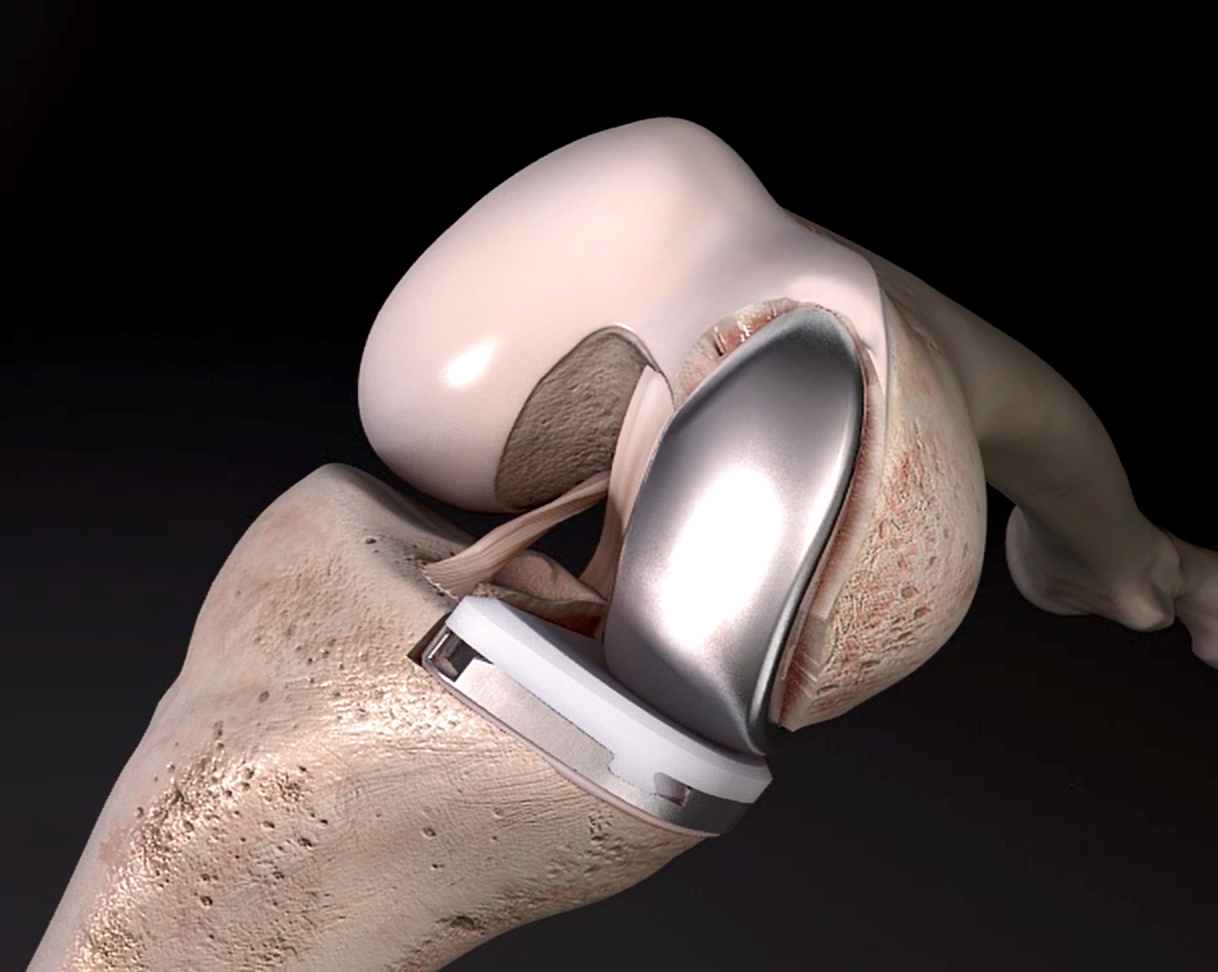
A partial knee replacement replaces only the damaged part of the knee rather than the whole joint. Most commonly this is the medial compartment — the inside half of the knee.
The replacement consists of metal components resurfacing the end of the femur and the top of the tibia, with a polyethylene plastic bearing between them to allow smooth movement.
The implants are usually fixed to the bone with acrylic bone cement.
Why might I need one?
Partial knee replacement is used for some patients with knee arthritis where the damage is limited to one part of the knee.
As with total knee replacement, surgery is usually considered when pain and loss of function remain significant despite appropriate non-surgical treatment.
What is the difference?
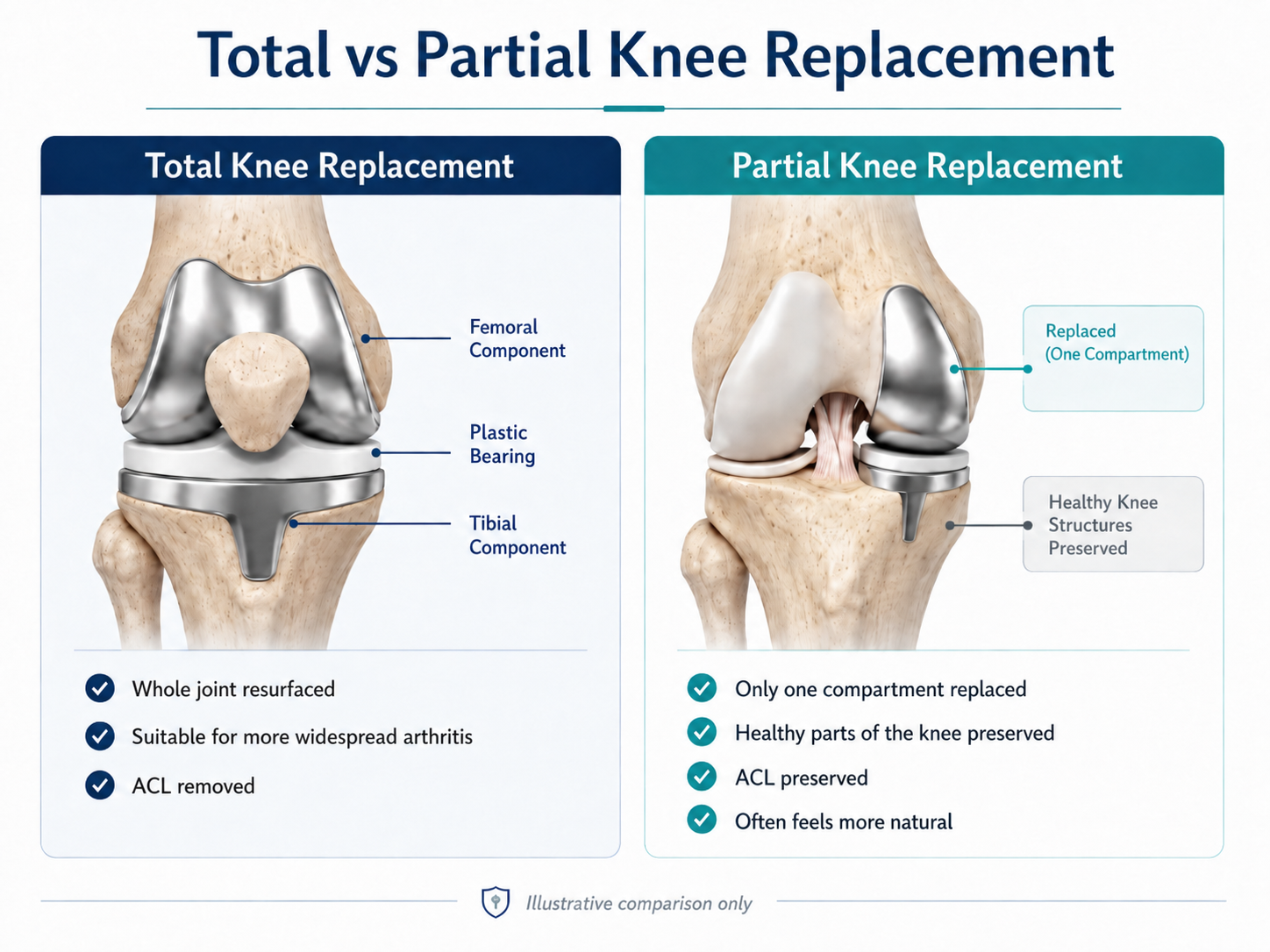
Partial knee replacement
- Only the damaged compartment is replaced.
- Healthy parts of the knee are preserved.
- The anterior cruciate ligament (ACL) is preserved.
- The knee may therefore retain better function.
Total knee replacement
- The whole joint surface is replaced.
- All compartments are resurfaced.
- The ACL is removed as part of the operation.
- It is suitable for more widespread arthritis.
Advantages and disadvantages
Potential advantages
- Shorter skin incision.
- Less pain, shorter hospital stay and faster recovery.
- Fewer serious complications such as infection, blood clots, heart attack, stroke and death.
- Better functional outcome.
- Lower rate of early reoperation.
- Better knee movement.
Potential disadvantages
- Only suitable for some patients with knee arthritis.
- Greater chance of needing further surgery over the longer term.
- It is technically demanding and consistent results are best achieved by dedicated specialists.
Before your operation
Pre-assessment
You will see your surgeon to discuss your diagnosis, treatment options and the risks of surgery. A pre-assessment appointment usually takes place a few weeks before the operation.
- Blood tests, swabs and an ECG may be performed.
- You will be told which medicines need to be stopped and when.
- You will receive instructions about when to come into hospital.
Prepare your body for surgery
- Stay active and keep the knee moving.
- Maintain strength with exercises such as leg raises and squats if you can manage them.
- Stop or reduce smoking if possible.
- If you are overweight, weight reduction may help lower the risk of complications, particularly infection.
On the day of surgery
Your surgeon will see you before surgery, confirm that you wish to proceed and mark the correct leg. You will then be taken to theatre for the anaesthetic.
The anaesthetic is most commonly a spinal anaesthetic with sedation. The spinal numbs the lower half of the body and sedation allows you to sleep through the procedure.
A tourniquet may be placed around the top of the thigh to reduce bleeding. The knee is cleaned with antiseptic and prepared for surgery.
What the surgeon does
The damaged surfaces of the femur and tibia are shaped so the partial knee implants fit accurately. Metal components and a polyethylene bearing are then positioned.
The wound is closed with absorbable sutures and skin glue. A dressing is applied and no restrictive bandages are normally used, allowing the knee to move freely.
Immediately after surgery
Eat & drink early
Eating and drinking soon after surgery helps recovery, blood pressure and nausea.
Regular medication
You will receive pain relief, anti-sickness medication, blood-thinning treatment and laxatives as required.
Walk the same day
It is safe to fully weight-bear immediately. The physiotherapy team will help you stand and walk on the day of surgery.
When will I go home and recover?
Most patients are safe to go home on the day of surgery or the following day. A longer stay may occasionally be needed for people who are frail or have multiple medical problems.
Home
Many patients leave hospital with two sticks once they can walk safely, manage the toilet and use stairs if needed.
Pain & swelling
Pain, warmth and swelling are expected early on. Stronger painkillers such as codeine can often be reduced after about two weeks.
Driving & swimming
You may drive when you can safely control the car and perform an emergency stop. Swimming can usually restart around this stage.
Activity returns
Golf and gym activity can often restart from 8–10 weeks. Knee movement may continue improving for around six months.
When to contact the hospital
- Fluid leaking from the dressing.
- Increasing pain that is not controlled with painkillers.
- Increasing pain or redness in the calf.
If any of these occur, contact the hospital where you had your surgery.
How long will a partial knee replacement last?
Partial knee replacement can give excellent long-term results, but on average the chance of needing further surgery is higher than after a total knee replacement. Using rounded contemporary registry figures, the approximate cumulative chance of revision is:
| Years since surgery | Total knee replacement | Partial knee replacement |
|---|---|---|
| 1 year | ~1% | ~2% |
| 5 years | ~3% | ~7% |
| 10 years | ~5% | ~13% |
| 20 years | ~8% | ~30% |
Risks and complications
Most partial knee replacements are successful and patients recover well, but complications can occur. To make the risks easier to understand, the main complications are grouped below by approximate frequency.
Rare complications
Approximately 1 in 50 to 1 in 140 patients
about 0.7%–2%, depending on the complication and the time period measured
- Kidney injury after surgery
- Fracture around the knee replacement over the lifetime of the implant
- Ligament or tendon injury
- Infection
- Blood clot in the leg or lung (DVT / pulmonary embolus)
Very rare complications
Approximately 1 in 350 to 1 in 825 patients
about 0.1%–0.3%, depending on the complication and the time period measured
- Stroke
- Heart attack
- Death within 90 days of surgery
- Blood vessel damage
- Amputation
- Nerve damage
Would you like to discuss partial knee replacement?
If you are considering knee replacement and would like to discuss whether a partial knee replacement is suitable for you, please get in touch.
Spire Hull: 01482 672477
Procedure code for insurers: W5210
This page is intended as general patient information and does not replace individual advice from your surgeon or anaesthetist.