Total Knee Replacement
A practical guide to total knee replacement: why it may be recommended, how to prepare, what happens on the day, recovery, risks, implant longevity and expected outcomes.
What is a knee replacement?
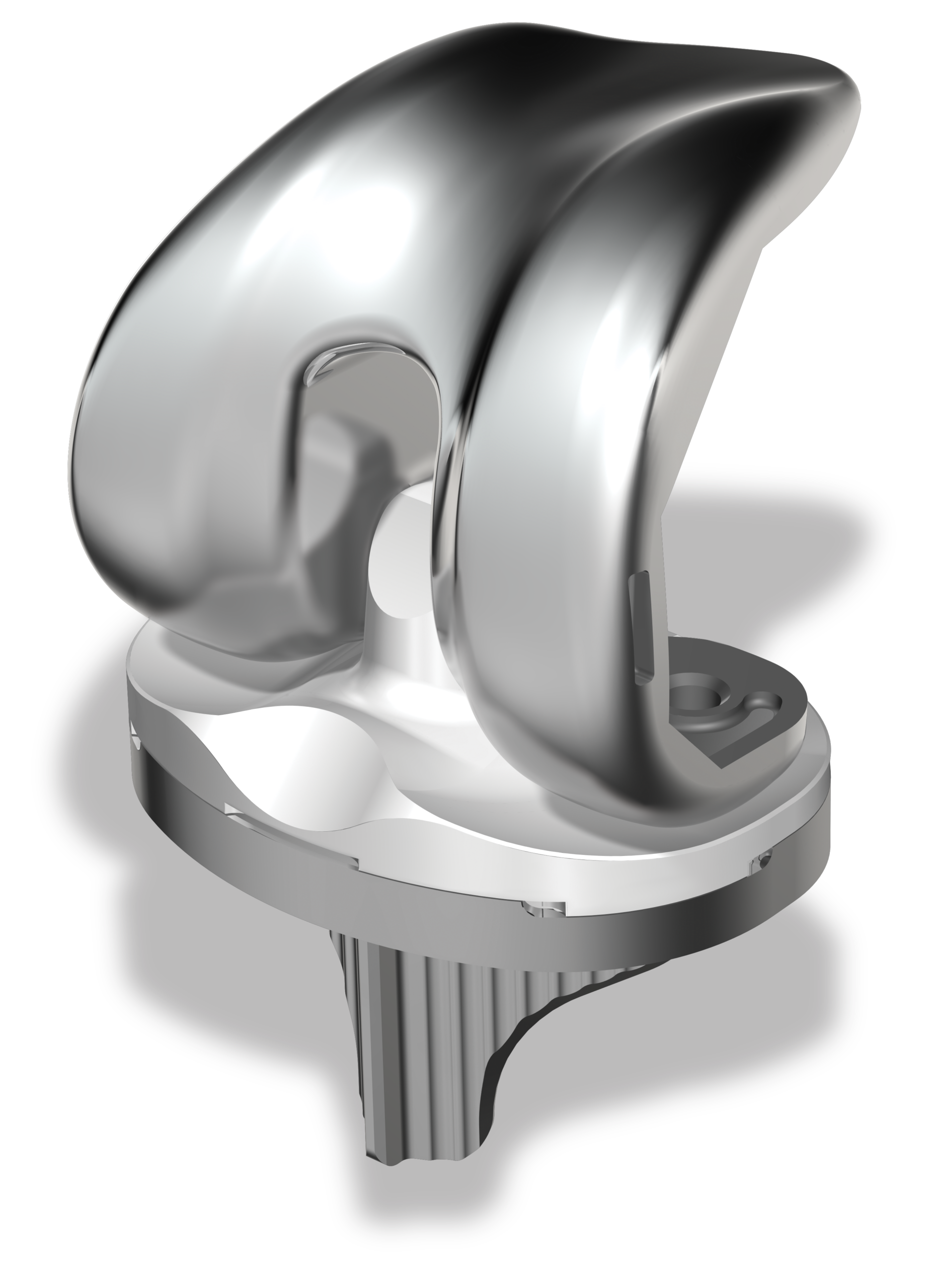
A knee replacement, or knee arthroplasty, is an operation in which the damaged surfaces of the knee are replaced with artificial components.
A metal component resurfaces the end of the thigh bone (femur), another metal component replaces the top of the shin bone (tibia), and a polyethylene plastic insert sits between them to allow smooth movement as the knee bends.
Most knee replacements are made from cobalt-chrome alloy with a polyethylene bearing and are usually secured to the bone using acrylic bone cement.
Why might I need one?
Most total knee replacements are performed for severe pain and/or restricted function caused by knee arthritis.
Because knee replacement is a major procedure and recovery takes several months, non-surgical treatments should usually be tried first.
Before your operation
Pre-assessment
You will see your surgeon before surgery to discuss your diagnosis, treatment options and the risks of surgery. A pre-assessment appointment usually takes place a few weeks before the operation.
- Blood tests, swabs and an ECG may be performed.
- You will be told which medicines need to be stopped and when.
- You will receive instructions about when to come into hospital.
Improve your fitness for surgery
- Stay active; even short walks help maintain strength and fitness.
- Stop or reduce smoking if you can.
- If you are overweight, weight reduction can help lower the risk of complications, particularly infection.
- Keep the knee moving and maintain muscle strength. Leg raises and squats are useful if you can manage them.
On the day of surgery
Your surgeon will see you before surgery, confirm that you wish to proceed and mark the correct leg. You will then be taken to theatre for the anaesthetic.
The anaesthetic is most commonly a spinal anaesthetic with sedation. The spinal numbs the lower half of the body and the sedation allows you to sleep through the procedure.
A tourniquet may be placed around the top of the thigh to reduce bleeding. The skin is cleaned with antiseptic and an incision is made down the front of the knee.
What the surgeon does
The ends of the femur and tibia are shaped using surgical instruments so the implants fit accurately. The metal components and polyethylene bearing are then positioned. A polyethylene button may also be used on the underside of the kneecap in some cases.
The wound is closed with absorbable sutures and skin glue. A dressing is applied, but no restrictive bandages are normally used so the knee can move freely.
Immediately after surgery
Eat & drink early
Eating and drinking soon after surgery helps recovery, blood pressure and nausea.
Regular medication
You will receive pain relief, anti-sickness medication, blood-thinning treatment and laxatives as required.
Walk the same day
It is safe to fully weight-bear immediately. The physiotherapy team will help you stand and walk on the day of surgery.
When will I go home and recover?
Most patients are safe to go home on the day of surgery or the following day. A longer stay may occasionally be needed for people who are frail or have multiple medical problems.
Home
Many patients leave hospital with two sticks once they can walk safely, manage the toilet and use stairs if needed.
Pain & swelling
Pain, warmth and swelling are expected early on. Stronger painkillers such as codeine can often be reduced after about two weeks.
Driving & swimming
You may drive when you can safely control the car and perform an emergency stop. Swimming can usually restart at around this stage.
Activity returns
Golf and gym activity can often restart from 8–10 weeks, while improvement in movement can continue for up to around six months.
Movement and returning to normal life
- Work hard on knee movement as swelling settles.
- Knee movement can continue to improve for about 6 months after surgery.
- Average return to work is around 3 months, although some patients take longer.
- Average return to an 18-hole round of golf is around 4–6 months.
When to contact the hospital
- Fluid leaking from the dressing.
- Increasing pain that is not controlled with painkillers.
- Increasing pain or redness in the calf.
If any of these occur, contact the hospital where you had your surgery.
How long will my knee replacement last?
Longevity depends on age and individual risk factors. National Joint Registry figures quoted in the leaflet show:
This means that about 1 in 13 patients require revision surgery within 18 years.
The leaflet also gives an approximate lifetime revision risk of 1 in 3 for patients under 50 at the time of their first knee replacement, falling to less than 1 in 150 for patients over 90.
Factors including younger age, male sex, heart disease, diabetes and obesity can increase the likelihood of revision surgery.
What results can I expect?
Knee replacement is a successful operation for most patients. The leaflet states that around 4 out of 5 patients are happy with the result of their operation one year after surgery.
My patient-reported outcomes
I routinely monitor outcomes using Patient-Reported Outcome Measures (PROMs). These are questionnaires completed before and after surgery that assess pain, walking, everyday activities, mobility and overall quality of life.
These improvements are greater than the published NHS averages shown in the leaflet: +19.0 for Oxford Knee Score, +0.37 for EQ-5D and +12.0 for overall health (VAS).
Risks and complications
Most total knee replacements are successful and patients recover well, but knee replacement is a major operation and complications can occur. To make the risks easier to understand, the complications listed in the patient information leaflet are grouped below by approximate frequency.
Rare complications
Approximately 1 in 50 to 1 in 140 patients
about 0.7%–2%, depending on the complication and the time period measured
- Kidney injury after surgery
- Fracture around the knee replacement over the lifetime of the implant
- Ligament or tendon injury
- Infection
- Blood clot in the leg or lung (DVT / pulmonary embolus)
Very rare complications
Approximately 1 in 350 to 1 in 825 patients
about 0.1%–0.3%, depending on the complication and the time period measured
- Stroke
- Heart attack
- Death within 90 days of surgery
- Blood vessel damage
- Amputation
- Nerve damage
Would you like to discuss knee replacement?
If you are considering total knee replacement and would like to discuss whether surgery is suitable for you, please get in touch.
Spire Hull secretary: 01482 67251
Procedure code for insurers: W4210
This page is intended as general patient information and does not replace individual advice from your surgeon or anaesthetist.